


Introduction Why AI Matters in Industrial Automation
In the past, industries relied heavily on mechanical systems, repetitive programming, and manual supervision to keep factories running. Today, the landscape has shifted dramatically with the rise of artificial intelligence in industrial automation. Machines are no longer just tools; they are decision-makers, capable of learning, adapting, and optimizing processes in real time. This shift is reshaping manufacturing, supply chains, and even the way workers engage with technology.
Artificial intelligence is not just an abstract buzzword, it’s the engine driving the next industrial revolution. From real-time quality control to predictive maintenance, AI is enabling factories and industries to become smarter, safer, and more efficient.
Table of Contents
Evolution of AI in Industry
The journey from traditional automation to intelligent systems has been gradual yet groundbreaking.
- Early adoption: Automation first entered industries through simple machines designed to handle repetitive tasks, such as assembly lines.
- Machine learning in industrial automation: As AI grew, data began to play a central role. Instead of rigid rules, machine learning models started analyzing complex datasets to improve efficiency and outcomes.
- From programming to intelligence: What once required manual coding can now be achieved through systems that adapt automatically based on data inputs.
This evolution highlights how industries are moving from being process-driven to being intelligence-driven.
Key Benefits of Artificial Intelligence in Industrial Automation
The appeal of AI lies in its measurable impact on businesses:
- Efficiency and productivity: Machines equipped with AI algorithms can optimize production schedules, reduce downtime, and maximize output.
- Cost reduction: By identifying inefficiencies, AI helps minimize energy use, reduce material waste, and save labor costs.
- Workplace safety: AI-powered robots often take on hazardous tasks, keeping human workers safe in dangerous environments.
These advantages make AI a necessity rather than a luxury in modern industries.
Artificial Intelligence in Industrial Decision Making, Control, and Automation
One of the most exciting applications is in industrial decision-making and control.
- Real-time monitoring: AI systems process data from thousands of sensors simultaneously, identifying anomalies that humans might miss.
- Quality control: Cameras powered by AI detect product defects faster than traditional human inspections, ensuring consistent quality.
- Optimization: AI-driven control systems continuously adjust operations to maintain peak performance.
In short, AI turns raw data into actionable insights that improve both speed and accuracy in industrial operations.
AI in Factory Automation How Smart Factories Work
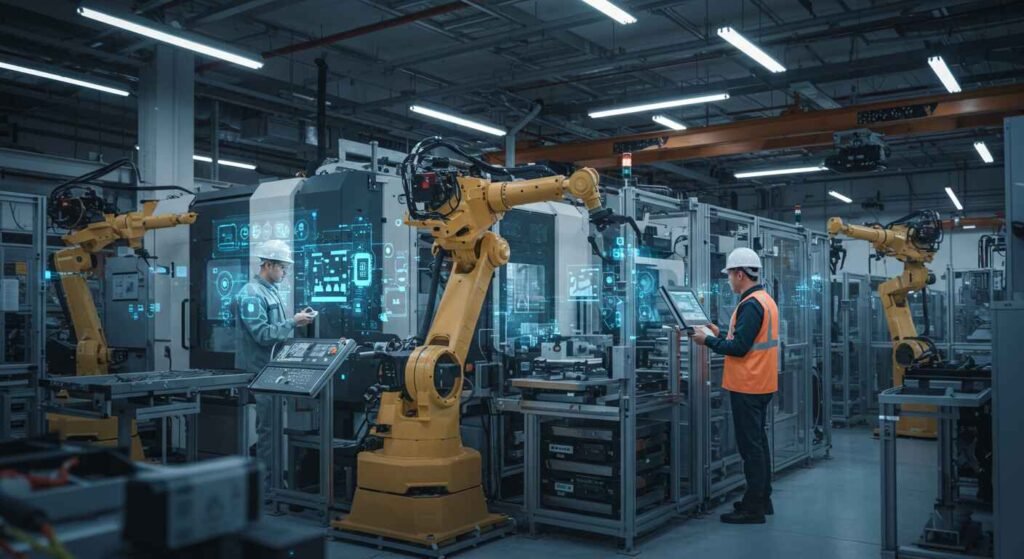
The concept of a “smart factory” is no longer futuristic it’s here. AI in factory automation combines robotics, IoT devices, and predictive analytics.
- Smart sensors: Devices embedded in equipment collect data about temperature, pressure, and performance. AI analyzes this information to detect problems early.
- Collaborative robots (cobots): AI-powered cobots work alongside humans, assisting in precision-heavy tasks without replacing the human role.
- Case studies: Companies like Siemens and Tesla are already using AI to streamline their production, creating flexible and adaptive factory environments.
This synergy is why the idea of the “factory of the future” is becoming reality.
AI in Manufacturing Case Study Insights
Practical examples reveal how industries use AI to stay competitive:
- Predictive maintenance: Instead of waiting for a machine to fail, AI predicts when maintenance is required, saving millions in downtime.
- Supply chain optimization: AI forecasts demand, manages inventory, and reduces transportation delays.
- Energy efficiency: By analyzing usage patterns, AI helps cut unnecessary energy consumption, lowering costs and environmental impact.
These AI in manufacturing case studies prove that intelligent automation is a driver of resilience and profitability.
Role of Machine Learning in Industrial Automation
Machine learning forms the backbone of AI in industry.
- Data collection and training: Industrial systems generate terabytes of data daily. Machine learning models turn this data into useful patterns.
- Anomaly detection: AI identifies subtle deviations in production lines that humans may overlook, preventing defects before they scale.
- Adaptive systems: Reinforcement learning allows machines to improve processes continuously, making operations smarter over time.
Without machine learning, AI in automation would simply not be possible.
Automation and Artificial Intelligence in A&D Industry
The aerospace and defense (A&D) industry is another area where AI is transforming automation.
- Aircraft manufacturing: AI-driven robots assist in precision assembly and testing.
- Predictive maintenance: Aircraft and defense equipment rely on AI models to anticipate component failures.
- Security considerations: With such critical applications, AI systems in A&D must meet the highest standards of reliability and safety.
The impact of automation and artificial intelligence in A&D industry is profound, improving safety and reducing operational costs.
Challenges in Implementing AI in Industrial Automation
Despite its promise, AI adoption faces hurdles:
- Data integration: Many factories still run on legacy systems that don’t communicate well with modern AI.
- Cost concerns: Initial investment in AI-powered systems can be high, raising questions about return on investment.
- Skill gap: Engineers and operators need reskilling to handle AI-driven machinery and analytics.
Overcoming these challenges requires a long-term vision and strategic implementation.
Artificial Intelligence in Industrial Automation Courses and Training
As industries transform, so must their workforce. Artificial intelligence in industrial automation courses are becoming critical.
- Upskilling engineers: Workers need to understand not just how to operate machines, but how to manage AI systems.
- Training areas: Courses often cover robotics, machine learning, predictive analytics, and IoT integration.
- Company initiatives: Many corporations sponsor internal training to bridge the AI skills gap.
This ensures that humans and machines evolve together, not in isolation.
The Future of AI in Industrial Automation
The story of AI in automation is still being written.
- Edge AI: Processing data directly on devices reduces latency, making real-time responses faster.
- Generative AI: Used in product design, generative models help create prototypes in less time.
- Autonomous factories: A long-term vision where entire production lines adapt and self-manage without human input.
As artificial intelligence gets a lot smarter, we can expect industries to evolve in ways we’ve only imagined.
FAQs: Quick Answers for Common Questions
What is artificial intelligence in industrial automation?
It refers to the use of AI technologies like machine learning and robotics to optimize, monitor, and control industrial processes.
How is AI applied in factory automation?
AI is used in predictive maintenance, quality control, robotics, and smart sensors for real-time monitoring.
What are the biggest benefits of AI in manufacturing?
Efficiency, cost reduction, improved safety, and better decision-making are among the top benefits.
Which industries use AI in automation the most?
Manufacturing, aerospace, automotive, defense, and energy are leading sectors.
What skills are needed for AI in industrial automation?
Knowledge of robotics, machine learning, IoT, and data analysis is crucial for professionals in this field.
Conclusion
The integration of artificial intelligence in industrial automation represents the most significant leap forward since the original industrial revolution. Factories and industries that embrace AI gain not just efficiency but resilience and adaptability in a highly competitive world. While challenges remain, the combination of smarter machines and skilled human workers ensures a future where innovation thrives.
