

Short answer: What is SEO? SEO, short for search engine optimization, is the practice of improving a website so search engines can find it, understand it and show it for relevant searches. It works by making your pages easy to crawl, genuinely useful to readers and trusted by other sites.
SEO is not paid advertising, and no one can guarantee a number one ranking. Anyone asking “what is SEO” in 2026 also wants to know whether AI has changed it, so this guide covers how it works, the main types, timing and AI search.
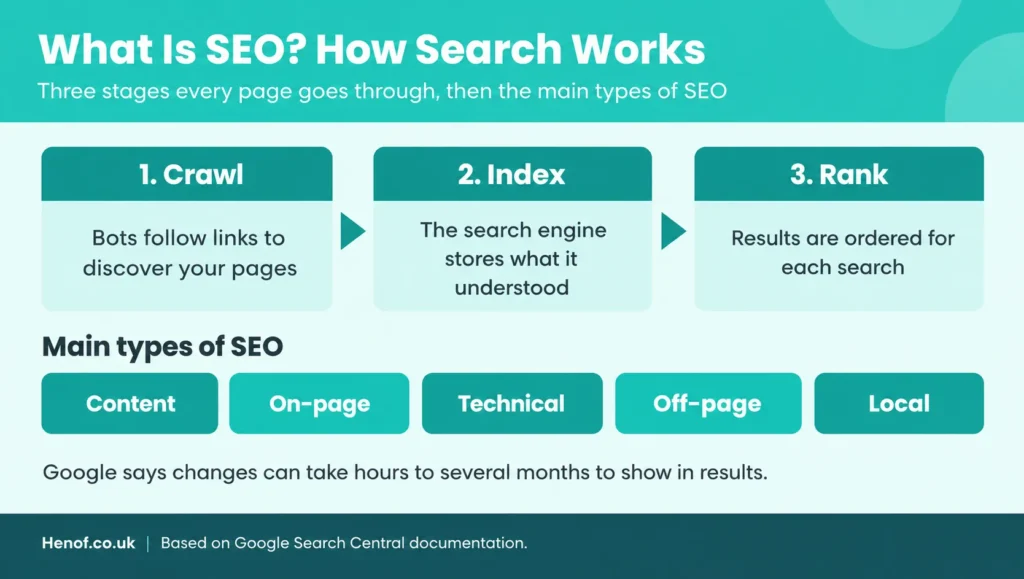
Table of Contents
Key Takeaways
- What is SEO in one line? It helps people find your pages through unpaid search results by improving content, structure and trust.
- Search engines work in three stages: they crawl pages, add them to an index and rank results for each query.
- Google says changes can take anywhere from hours to several months to show, so patience matters.
- AI answers have not replaced SEO. They still depend on pages that are crawlable, useful and trusted.
- Beginners can start with free tools and focus on helpful content before anything advanced.
How We Prepared This Guide
This guide is a sponsored contribution from SEO Dubai Pro, which describes itself as an SEO agency serving Dubai. Our team rewrote and fact-checked it against Google’s own documentation so readers get a plain answer to what is SEO, and sponsored links are marked as such. Read our disclaimer and about page for how Henof works.
What changed in this update: we replaced promotional claims with sourced explanations, corrected the Core Web Vitals advice, and added sections on AI search, doing SEO yourself and careers.
What Is SEO and How Does It Work?
SEO is about earning visibility in organic results, which are the unpaid listings on search engines. Google describes search in three stages: it crawls pages by following links, stores what it finds in an index, and serves results when someone searches. Google’s own SEO starter guide says creating compelling and useful content will likely influence your presence in results more than any other tip.
In practice, good SEO means three things: search engines can reach your pages, your pages match what people want, and other sites and users show they trust you.
Crawl, Index and Rank: The Three Stages
- Crawling: automated bots follow links to discover pages and read their content and code.
- Indexing: the search engine processes and stores what it understood about each page.
- Ranking: when someone searches, the engine picks and orders results from the index by relevance and quality.
If a page cannot be crawled or is blocked from indexing, it cannot rank, no matter how good the content is.
What Is SEO Made Of? The Main Types
| Type of SEO | What it covers | Simple example |
| Content SEO | Pages that answer what people search for | A clear guide that matches a search question |
| On-page SEO | Titles, headings, meta descriptions, internal links, images | A page title that states the topic clearly |
| Technical SEO | Crawling, indexing, speed, mobile use, site structure | Fixing broken links and slow pages |
| Off-page SEO | Signals from other sites, mainly links and mentions | A trusted site linking to your guide |
| Local SEO | Visibility for searches tied to a place | A business profile with accurate hours and address |
For a deeper look at one type, see our guide to local SEO for a service business.
What Is SEO Content and Search Intent?
Search intent is the reason behind a search: to learn, to compare, to buy or to find a place. Your page should match that intent and answer the question quickly, then add depth.
Use clear headings, short paragraphs and lists, and show real experience where you have it. Google’s guidance on helpful, people-first content and E-E-A-T (experience, expertise, authoritativeness and trust) applies to every topic, not just health or finance.
Technical SEO and Core Web Vitals
Core Web Vitals measure loading, interactivity and visual stability. Google’s published targets are a Largest Contentful Paint of 2.5 seconds or less, an Interaction to Next Paint of 200 milliseconds or less, and a Cumulative Layout Shift of 0.1 or less, as explained on web.dev.
Compress images, use reliable hosting, and avoid heavy scripts. A fast, mobile-friendly site helps users first and search engines second.
Links, Internal Linking and Trust
Beginners who search “what is SEO” often hear about backlinks first. Links from other sites can help show that your content is trusted, but quality matters more than quantity. Google’s spam policies say that buying or selling links to pass ranking signals breaks the rules, and paid or sponsored links should carry the right rel attribute.
Internal links help readers and search engines move through your site. For related reading, see our guide on fake traffic and click services and why they are a poor shortcut.
What Is SEO vs Paid Ads (PPC)?
SEO earns unpaid visibility over time, while PPC buys placement and stops when the budget stops. Many businesses use both: ads for faster visits and SEO for lasting visibility.
Neither is better in every case. Choose based on your timeline, budget and how competitive your keywords are.
Is SEO Dead Because of AI?
The next question after “what is SEO” is often whether AI has ended it. No, but search is changing. AI answers now appear next to classic results, and Google’s documentation on AI features and your website says the same SEO best practices still apply.
Terms such as AEO and GEO describe optimizing for AI answers. They build on the same basics: crawlable pages, clear answers, original value and trust. AI tools can speed up research and drafts, but mass-produced low-value pages can violate spam policies, so review everything before publishing.
Can You Do SEO Yourself?
Yes, if you are willing to learn. Beginners can handle content, titles, internal links and basic fixes without an agency.
Start with free tools: Google Search Console shows how your pages perform, and Google Analytics shows what visitors do. To learn more, read these digital marketing books and the skills digital marketing strategists need. If you prefer to hire, compare options in our list of top digital marketing agencies.
How Long Does SEO Take?
Google says some changes take effect in hours and others take several months, and not every change makes a noticeable difference. Many agencies quote three to six months for early results, but that is an industry rule of thumb, not a Google promise.
New sites, competitive keywords and thin content usually take longer. Track results in Search Console and keep improving.
How to Measure SEO
- Impressions and clicks from Google Search Console.
- Average position and click-through rate for your main pages.
- Engaged sessions and conversions in Google Analytics.
- Indexed pages and any crawl or indexing errors.
What Is SEO: Final Verdict
Now you have the answer to “what is SEO”: it is the long-term work of making your site easy to find, useful to read and trusted. It is not a trick, and it is not dead because of AI.
Start with helpful content and a technically sound site, measure what happens, and be careful with shortcuts. For more guides, browse our SEO category and our tips for social engagement.
About the Contributor
SEO Dubai Pro is an SEO agency serving Dubai and the wider region, according to its own description, and sponsored this guide. Henof edited and fact-checked it. The advice here is general and not a guarantee of results.
Frequently Asked Questions
What is SEO and how does it work?
SEO, or search engine optimization, is improving your website so search engines can find, understand and show it for relevant searches. Search engines crawl pages, add them to an index and rank results when someone searches.
Can I do SEO myself?
Yes. You can handle content, titles, internal links and basic fixes yourself with free tools such as Google Search Console. Complex technical work or large link campaigns may need specialist help.
Is SEO dead now with AI?
No, but search is changing. AI answers appear beside classic results, yet they still draw on pages that search engines can crawl and trust, so the fundamentals still matter.
What is replacing SEO?
Nothing has replaced it. Terms such as AEO and GEO describe optimizing for AI answers, and they build on the same basics of helpful content, clear structure and trust.
Can ChatGPT do SEO?
AI tools can help with outlines, keyword ideas and drafts, but they cannot replace testing, original experience or fact-checking. Publishing mass-produced low-value pages can break Google’s spam policies.
How long does SEO take to work?
Google says changes can take from a few hours to several months to show. Many agencies quote three to six months for early results, but it varies by competition and site.
What is an example of SEO?
A local bakery writes a helpful page about sourdough, uses a clear title, adds internal links, fixes slow images and keeps its business profile accurate, so it appears for relevant searches.
Are SEO jobs still in demand?
SEO roles exist in agencies, in-house teams and freelance work. Demand and pay vary by country and experience, so check current job listings in your market.
