

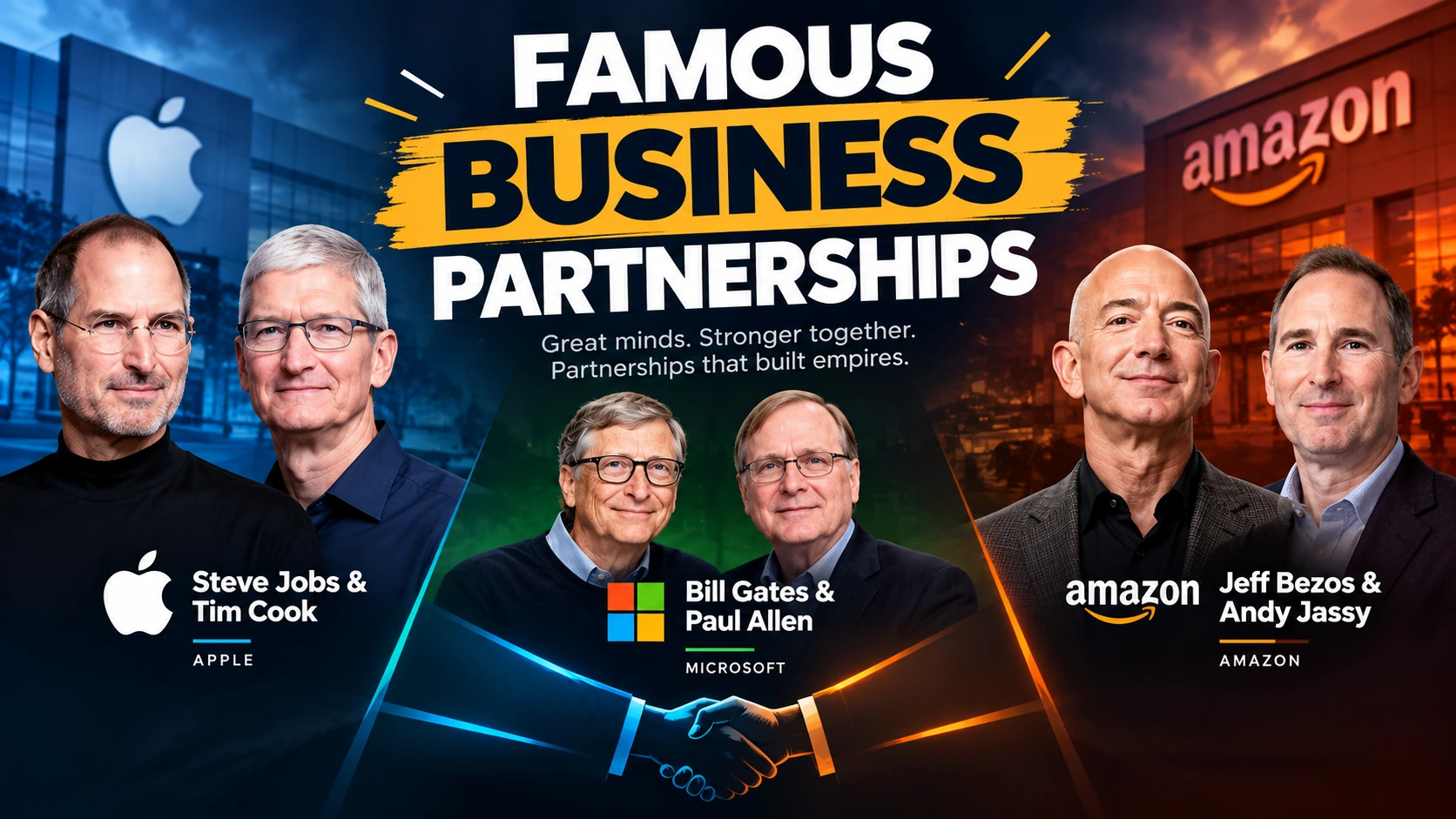
Short answer: Famous business partnerships such as Apple, Microsoft, Google, HP and Berkshire Hathaway worked because partners brought different skills, trusted each other and agreed on a shared goal. They also show that partnerships change: founders leave, owners sell and roles shift.
This guide covers 12 famous business partnerships, what made them work, how some changed or ended, and the legal basics to know before you partner with someone. It is general information, not legal advice.
Table of Contents
Key Takeaways
- The most famous business partnerships paired complementary skills, such as vision with engineering, or product with business.
- Trust and clear roles matter more than friendship alone.
- Partnerships evolve. Apple lost a co-founder early, Berkshire’s partners aged, and Ben & Jerry’s faced a rift years after its sale.
- Put roles, money, decisions and exit terms in a written agreement before problems start.
- Legal structure affects liability, so choose it with professional advice.
How We Prepared This Guide
We used public company histories of famous business partnerships, 2026 news for recent changes at Berkshire Hathaway and Ben & Jerry’s, and general business-structure guidance. We did not interview any of the people mentioned. Read our disclaimer and about page for how Henof works.
What changed in this update: we corrected the earlier mix-ups, removed Twitter because it was misfiled under finance and left out some co-founders, removed Oracle from the hardware group, dropped the Oprah Winfrey and Gayle King example because it is not a founding partnership, and added recent news and legal basics.
Famous Business Partnerships at a Glance
| Partners | Company | Started | Why it matters |
| William Procter and James Gamble | Procter & Gamble | 1837 | A candlemaker and a soapmaker combined trades |
| Bill Hewlett and Dave Packard | HP | 1939 | Garage start that helped shape Silicon Valley |
| Phil Knight and Bill Bowerman | Nike (as Blue Ribbon Sports) | 1964 | A runner-businessman and a coach built a brand |
| Warren Buffett and Charlie Munger | Berkshire Hathaway | 1965 | Decades-long partnership built on trust |
| Bill Gates and Paul Allen | Microsoft | 1975 | School friends who built software for PCs |
| Steve Jobs and Steve Wozniak | Apple | 1976 | Vision and engineering paired together |
| Ben Cohen and Jerry Greenfield | Ben & Jerry’s | 1978 | Values-led brand, later tested by a corporate owner |
| Larry Page and Sergey Brin | 1998 | Stanford students who reshaped search | |
| Brian Chesky, Joe Gebbia, Nathan Blecharczyk | Airbnb | 2008 | Design, product and engineering skills combined |
| Patrick and John Collison | Stripe | 2010 | Brothers who built payments infrastructure |
| Richard and Maurice McDonald, with Ray Kroc | McDonald’s | 1955 (franchise) | A fast-food system scaled by a partner, then a buyout |
| Wilbur and Orville Wright | Wright Company | 1909 | Brothers who split inventing and business roles |
Famous Business Partnerships in Technology
Steve Jobs and Steve Wozniak: Apple (1976)
Jobs focused on product and vision, while Wozniak was the engineer who designed the early computers. A third co-founder, Ronald Wayne, left within weeks. Lesson: a mix of vision and technical skill works, but roles and equity should be clear from the start.
Bill Gates and Paul Allen: Microsoft (1975)
The two met at Lakeside School in Seattle and bonded over programming. They built software for early personal computers, and Allen later left day-to-day work and died in 2018. Lesson: shared early interests can build trust that lasts through change.
Larry Page and Sergey Brin: Google (1998)
The pair met at Stanford and built a search engine that became the core of Google. Lesson: a strong technical idea and two committed founders can scale fast.
Brian Chesky, Joe Gebbia and Nathan Blecharczyk: Airbnb (2008)
Airbnb combined design, product and engineering skills across three co-founders. Lesson: partnerships do not have to be pairs, and skills should cover the whole business.
Patrick and John Collison: Stripe (2010)
The Collison brothers built payments tools for internet businesses. Lesson: family partners can work when they share goals and trust each other’s judgment.
Famous Business Partnerships in Food, Retail and Consumer Brands
Ben Cohen and Jerry Greenfield: Ben & Jerry’s (1978)
The two started in a renovated gas station in Burlington, Vermont. Unilever bought the company in 2000 for $326 million, with terms meant to protect its social mission.
In September 2025, Greenfield resigned after 47 years, saying the brand’s independence had been lost, while Unilever’s ice cream business, The Magnum Ice Cream Company, disagreed. Lesson: when you sell, the agreement on control and values must be written clearly and enforceable.
Richard and Maurice McDonald and Ray Kroc: McDonald’s
The McDonald brothers created a fast, efficient restaurant system, and Ray Kroc began franchising it in 1955. Kroc later bought the brothers out. Lesson: great systems scale through partners, but unclear terms can end badly.
William Procter and James Gamble: Procter & Gamble (1837)
A British-born candlemaker and an Irish-born soapmaker joined forces in the 1830s. Their trades overlapped on raw materials, which made the partnership practical. Lesson: look for partners whose skills complement yours.
Phil Knight and Bill Bowerman: Nike (1964)
They started Blue Ribbon Sports, which later became Nike. One brought business drive and the other product ideas from coaching track athletes. Lesson: different strengths build a stronger brand.
Famous Business Partnerships in Investing and Industry
Warren Buffett and Charlie Munger: Berkshire Hathaway
Buffett took control of Berkshire in 1965, and Munger became a central partner and later vice chairman. Munger died in 2023, and Buffett stepped down as CEO on December 31, 2025, with Greg Abel taking over on January 1, 2026. Buffett remains chairman. Lesson: plan succession early.
Bill Hewlett and Dave Packard: HP (1939)
They started in a garage and reportedly flipped a coin to decide whose name came first. HP became a major technology company. Lesson: strong engineering and mutual respect can last for decades.
Wilbur and Orville Wright
The brothers divided their work: Wilbur led the business side as president of the Wright Company, while Orville focused on invention. Lesson: split roles so each partner owns a clear area.
What Made Famous Business Partnerships Work?
- Complementary skills: each partner covered something the other could not.
- Trust and respect: partners relied on each other’s judgment and divided work fairly.
- Shared goals: a common mission kept them aligned in tough times.
- Open communication: they discussed problems early and directly.
For the leadership side of partnerships, see our guide to the changing face of business leadership.
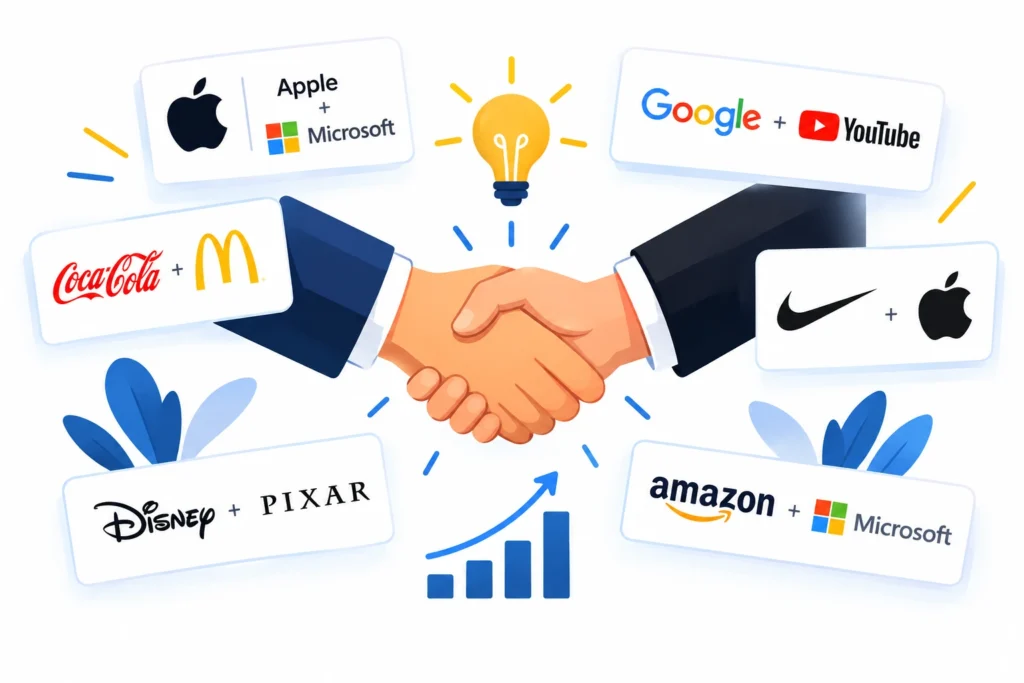
When Famous Business Partnerships Change or End
Even the best partnerships change. Co-founders leave, owners sell, and health or age shifts roles. Apple lost a co-founder in its first weeks, Microsoft’s Paul Allen stepped away from daily work, McDonald’s brothers sold out to Kroc, and Ben & Jerry’s faced a values dispute with its parent.
The lesson is to plan for change: write exit terms, define decision rights and agree how disputes will be resolved before they happen.
Legal Basics Behind Famous Business Partnerships
This is general information, not legal advice, and rules vary by country and state. Talk to a lawyer or accountant before you choose a structure.
| Structure | How it works in general | Personal liability |
| General partnership | Two or more people share profits, losses and management | Partners are typically personally liable for business debts |
| Limited partnership (LP) | General partners run the business; limited partners invest | General partners are liable; limited partners are usually limited to their investment |
| Limited liability partnership (LLP) | A partnership where partners get liability protection, often used by professional firms | Protects partners from some liabilities; rules vary by location |
| Limited liability company (LLC) | Owners are called members and can set rules in an operating agreement | Members are generally shielded from business debts, with exceptions |
For official overviews, see the IRS guide to partnerships and the SBA guide to choosing a business structure. Our beginner guide to what capital is in business can help you plan investment splits.
Can a 51% Owner Fire a 49% Owner? Common Ownership Questions
It depends on the structure, the agreement and the person’s role. A majority owner may control some decisions, but operating or shareholder agreements and the law may protect minority owners, so check the documents first.
In a 50/50 partnership, deadlock is the main risk. Look for buy-sell terms, mediation clauses or a buyout process in your agreement, and get legal advice before you act.
Tips from Famous Business Partnerships to Build Your Own
- Talk openly about goals, roles, money and workload before you start.
- Write a partnership or operating agreement covering profit split, decisions, deadlock and exit.
- Test compatibility with a small project first.
- Review roles and equity regularly as the business grows.
- Get financial help early. See how business bankers help small businesses and why small business accountants matter.
Famous Business Partnerships: Final Verdict
The best famous business partnerships combined complementary skills, trust and clear roles, and they adapted when circumstances changed.
Use these famous business partnerships as lessons, not guarantees, and put your own agreement in writing. For more guides, visit our business category.
About the Author
Abubakr is a content writer covering business and entrepreneurship topics at Henof. This guide is research-based and not legal or financial advice. Reviewed by Afaque Hussain, link building and outreach specialist.
Frequently Asked Questions
What are some famous business partnerships?
Well-known examples include Steve Jobs and Steve Wozniak (Apple), Bill Gates and Paul Allen (Microsoft), Larry Page and Sergey Brin (Google), Bill Hewlett and Dave Packard (HP), Ben Cohen and Jerry Greenfield (Ben & Jerry’s), William Procter and James Gamble (Procter & Gamble), Warren Buffett and Charlie Munger (Berkshire Hathaway), and Phil Knight and Bill Bowerman (Nike).
What makes famous business partnerships successful?
Complementary skills, trust, clear roles, open communication and a written agreement that covers money, decisions and exits.
Is Amazon a partnership?
No. Amazon is a publicly traded corporation, not a partnership.
Can a 51% owner fire a 49% owner?
It depends on the business structure, the governing documents and the person’s role. A majority owner may control some decisions, but agreements and law can protect minority owners, so get legal advice.
How do you get out of a 50/50 partnership?
Start with the partnership or operating agreement, which may include buy-sell or exit terms. Common routes are negotiation, mediation, a buyout or dissolution, and a lawyer can advise on your situation.
What is an LLP?
LLP stands for limited liability partnership, a partnership structure that gives partners some protection from liabilities. Rules differ by location, and it is often used by professional firms.
Which is better, a limited partnership or an LLC?
Neither is better for everyone. An LLC usually offers limited liability to all members with flexible management, while a limited partnership has general partners who carry liability. Choose based on your goals and advice from a professional.
Can I be sued personally if I have an LLC?
An LLC generally protects personal assets from business debts, but not from your own wrongdoing, personal guarantees, or poor separation of personal and business money. Ask a lawyer about your case.
