

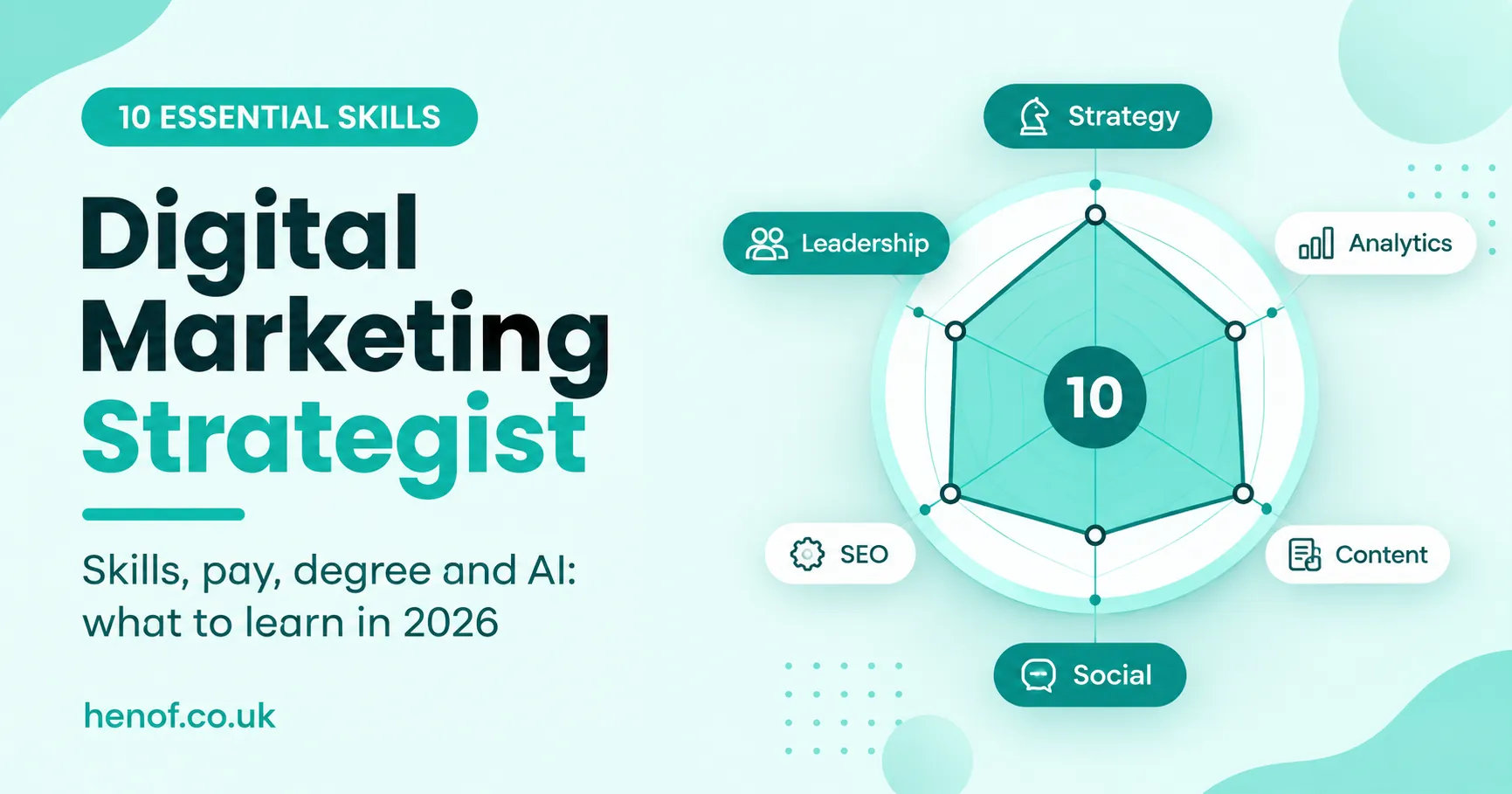
Short answer: A digital marketing strategist plans how a business uses search, content, social media, email and paid ads together to reach its goals, then measures the results and adjusts. The ten essential skills are strategic thinking, analytics, content, SEO and paid search, social media, communication, technical tools, adaptability, creativity and leadership.
This guide explains what the role involves, each skill, how pay and degrees work, and how AI changes the job in 2026. It is research-based, and we did not interview employers for it.
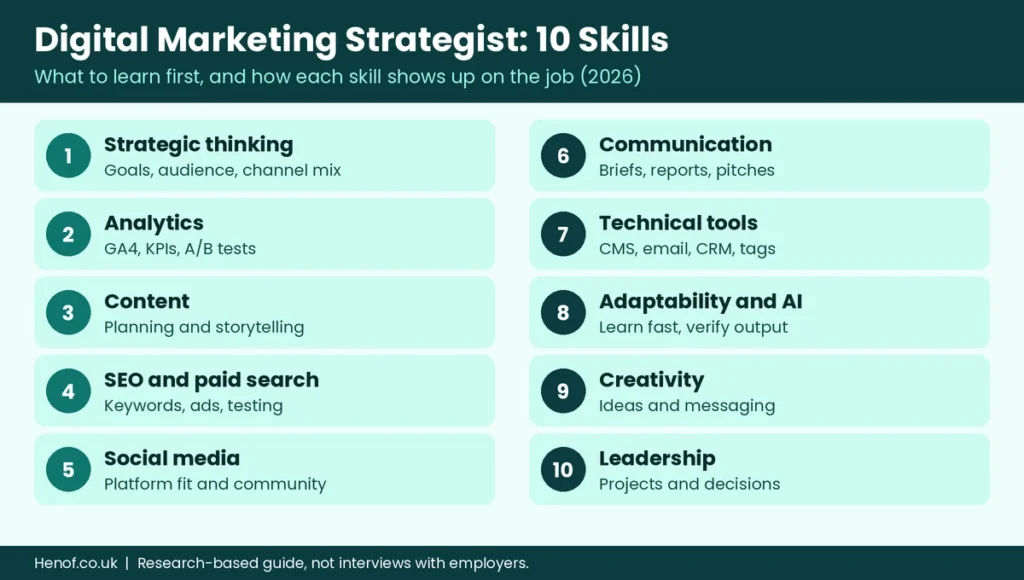
Table of Contents
Key Takeaways
- A strategist plans and connects channels, while a specialist usually runs one or two of them.
- Strategic thinking and analytics come first, because every other skill depends on knowing the goal and measuring the result.
- The US median wage for the related group of market research analysts and marketing specialists was $78,760 in May 2025.
- A degree helps in many hiring processes, but a portfolio with real results can matter as much.
- AI changes tasks more than it replaces strategy, so build AI literacy and keep checking its output.
How We Prepared This Guide
We reviewed 2026 job descriptions and career pages, and used the US Bureau of Labor Statistics for pay and education data. We did not test the skills ourselves. Read our disclaimer and about page for how Henof works.
What changed in this update: we replaced old Google Analytics advice with GA4 terms, moved Google Tag Manager out of the automation category, and added pay, degree, AI and marketing rules of thumb.
What Does a Digital Marketing Strategist Do?
A digital marketing strategist sets the plan for a brand’s online presence and makes sure each channel supports the same business goal. Typical work includes audience research, planning campaigns, choosing channels, setting budgets and reporting results.
The role is about decisions, not just execution. A strategist asks what to do, why, in what order, and how to know whether it worked.
Strategist vs specialist vs manager
| Role | Main focus | Typical scope |
| Strategist | Plans how channels work together | Goals, audience, channel mix, measurement |
| Digital marketing specialist | Runs one or two channels | SEO, paid ads, email or social execution |
| Marketing manager | Leads people and budgets | Team, budget, results across campaigns |
Digital Marketing Strategist Skills at a Glance
| Skill | What it looks like | How to build it |
| 1. Strategic thinking | Goals, audience, channel mix, budget | Plan a small campaign for a real goal |
| 2. Analytics and measurement | GA4, conversions, UTMs, A/B tests | Build a simple dashboard for a site |
| 3. Content marketing | Planning, storytelling, clear writing | Publish and review a content calendar |
| 4. SEO and paid search | Keywords, on-page SEO, ad testing | Optimize one page and run a small ad test |
| 5. Social media | Platform fit, community, paid social | Test posts and read the results |
| 6. Communication | Reports, briefs, presentations | Present results to a non-expert |
| 7. Technical tools | CMS, email, CRM, tag management | Set up a small site and email flow |
| 8. Adaptability and AI literacy | Learning fast, using AI with checks | Test AI tools on real tasks and verify output |
| 9. Creativity | Ideas, messaging, offers, visuals | Write three angles for every campaign |
| 10. Leadership | Project management, delegation, decisions | Lead a small project end to end |
10 Essential Skills Every Digital Marketing Strategist Needs
1. Strategic thinking
A strategist turns business goals into a plan: who the audience is, which channels to use, what to say and how to spend the budget. Funnel thinking, from awareness to consideration to conversion, helps decide where each channel fits.
2. Analytics and measurement
Strategists need to read data and act on it. In Google Analytics 4, engagement rate and conversions replaced much of the old bounce-rate focus, and UTM parameters help track which campaigns bring results.
Know the common KPIs: cost per click, return on ad spend, conversion rate and cost per acquisition. A/B testing helps compare two versions of an ad or page.
3. Content marketing
Content builds trust and traffic. Strategists plan what to publish, shape the story and set quality standards for blog posts, videos, emails and social posts.
4. SEO and paid search
SEO earns unpaid visibility, while search ads buy it. A strategist should understand keyword research, on-page SEO, technical basics and ad testing. For a primer, read what SEO is and how it works.
5. Social media
Know how each platform works and which audience it reaches. Our guides to social media engagement and influencer marketing channels cover practical tactics.
6. Communication
Strategists explain plans to clients and teammates in plain language, write clear briefs and present results honestly, including what did not work.
7. Technical tools
You do not need to be a developer, but you should know a CMS such as WordPress, an email platform, a CRM and basic HTML. Google Tag Manager is a tag management tool that helps deploy tracking, and automation tools such as Zapier connect apps.
8. Adaptability and AI literacy
Platforms and algorithms change often. Strategists keep learning and test AI tools on real tasks such as research, drafts and reporting, while checking every output for accuracy and brand fit.
9. Creativity
Creative ideas and clear messaging help campaigns stand out. Good strategists test several angles instead of relying on one idea.
10. Leadership
Strategists often lead projects and coordinate writers, designers, developers and sales teams. That takes time management, delegation and decision-making.
Digital Marketing Strategist Pay, Degree and Career Path
Pay varies by country, employer and experience. The US Bureau of Labor Statistics does not list a digital marketing strategist category, but its related group of market research analysts and marketing specialists had a median wage of $78,760 in May 2025, and these roles typically need a bachelor’s degree, according to the BLS Occupational Outlook Handbook. Job boards often show different averages, so check listings in your own market.
Many strategist jobs are not entry level. People often start as specialists or coordinators, then move into planning and reporting once they have channel experience and results to show.
How to Become a Digital Marketing Strategist
- Learn the basics of SEO, content, social media, email and paid ads.
- Build a portfolio with real projects, such as a blog, a small business campaign or volunteer work.
- Take an entry role as a specialist or coordinator and learn analytics on the job.
- Add optional certifications, for example from Google Skillshop, HubSpot Academy or Meta Blueprint.
- Practise planning and reporting on larger projects, and keep learning AI tools.
For learning resources, see our list of digital marketing books and our guide to a digital marketing internship for freshers. When you are ready to apply, see how to craft a strong resume.
Will AI Replace the Digital Marketing Strategist?
AI is already automating drafting, reporting and testing, so some tasks will change. Strategy still needs judgment about goals, brand, ethics and trade-offs, and someone must be accountable for results.
A strategist who understands AI tools, checks their output and focuses on decisions is better positioned than one who ignores them.
Marketing Rules of Thumb You Will Hear
These are popular heuristics, not laws, so treat them as starting points:
- 4 types of digital marketing: commonly grouped as SEO, content marketing, social media marketing and paid advertising, with email and affiliate marketing often added.
- 70/20/10: a budget heuristic that puts most spend on proven tactics, some on emerging ones and a small share on experiments.
- Rule of 7: a folk belief that people need several exposures before they act. The exact number is not a proven law.
- 4 Ps: product, price, place and promotion, the classic marketing mix.
Do You Need to Hire a Digital Marketing Strategist?
If you run a business, a strategist can be a hire, a freelancer or an agency. Compare options in our list of top digital marketing agencies, and see our career paths guide if you are still choosing a direction.
Digital Marketing Strategist: Final Verdict
A strong strategist combines planning, data, channel knowledge and clear communication, and keeps learning as tools change.
Build one skill at a time, prove it on real projects and add AI literacy early. That path is slower than a shortcut, but employers and clients can verify it.
About the Author
Ashfaque is a content writer covering digital marketing and SEO at Henof. This guide is research-based and not based on interviews with employers. Reviewed by Afaque Hussain, link building and outreach specialist.
Frequently Asked Questions
What is a digital marketing strategist?
A strategist plans how a business uses channels such as search, content, social media, email and paid ads together to reach its goals, then measures results and adjusts the plan.
What skills does a digital marketing strategist need?
Core skills are strategic thinking, analytics, content, SEO and paid search, social media, communication, technical tools, adaptability, creativity and leadership.
How do I become a digital marketing strategist?
Learn the channels, work on real projects or a portfolio, start in a specialist or coordinator role, then take on planning and reporting. Certifications can help but are optional.
What degree do you need to be a digital strategist?
Employers often prefer a bachelor’s degree in marketing, business or communications, but a strong portfolio and proven results can matter as much. Requirements vary by employer.
How much do digital marketing strategists make?
Pay varies by country, employer and experience. In the US, the median wage for market research analysts and marketing specialists, a related group, was $78,760 in May 2025 according to the Bureau of Labor Statistics.
Will AI replace digital marketers?
AI is automating tasks such as drafting, reporting and testing, but strategy, judgment and accountability still need people. Marketers who learn to use AI and verify its output are in a stronger position.
Is a strategist an entry-level job?
Usually not. Many people start as specialists or coordinators, build channel skills, and move into strategist roles later.
Is digital marketing a good career?
It can be, if you enjoy data, creativity and constant change. It also brings deadlines, performance pressure and the need to keep learning.
